By Leilanie Adriano
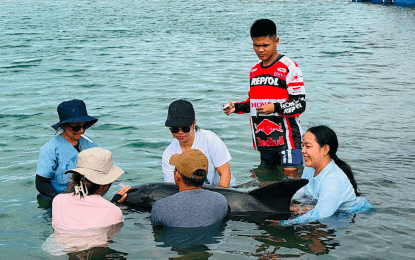
LAOAG CITY – A stranded sub-adult Risso’s dolphin (Grampus griseus) died on Monday, four days after being rescued in coastal Barangay Masintoc, Paoay, Ilocos Norte.
Vanessa Abegail Dagdagan-Alimbuyuguen, provincial fishery officer of Ilocos Norte, told the Philippine News Agency that the dolphin died at 7:12 am.
“The marine mammal was brought to the Mariano Marcos State University-College of Veterinary Medicine for necropsy procedure,” she said.
She added that the Bureau of Fisheries and Aquatic Resources, along with the Mariano Marcos State University (MSSU), the Philippine Marine Mammal Stranding Network (PMMSN), provincial and local government units, teamed up and tried to save the dolphin named “Marcu.”
The dolphin’s name was derived from a combination of the month and location where he was rescued, which is March and Culili Point of Masintoc.
In partnership with the MMSU and the Office of Ilocos Norte 2nd District Rep. Angelo Marcos Barba, a memorandum of agreement for the establishment of a rehabilitation facility for marine mammals is being reviewed, pending its construction.
According to the PMMSN, marine mammal strandings are now a common occurrence along the country’s coastlines.
Data shows that the Badoc-Currimao grid in Ilocos Norte is the hottest stranding hotspot in the Philippines.
An infographic released by the University of the Philippines’ Institute of Environmental Science and Meteorology on the basics of marine mammal emergency first response advises responders to approach stranded animals carefully by walking directly towards their center.
They are also told to call trained responders, protect the blowhole, avoid touching the eyes or lifting the pectoral fin, support the animal upright, and keep its skin wet.
The responders are further advised to avoid crowding, minimize noise, and shield the animal from the sun, wind, or cold to prevent causing additional stress or injury. (PNA)