By Connie Calipay
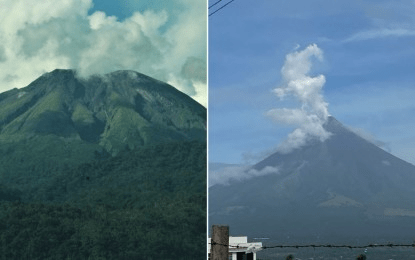
LEGAZPI CITY – Mayon Volcano continues to show intensified magmatic unrest, while Bulusan Volcano remains under low-level unrest, according to the latest monitoring of the Philippine Institute of Volcanology and Seismology on Friday.
Mayon Volcano is currently under Alert Level 3, indicating ongoing magmatic activity that may lead to hazardous eruptions.
Over the past 24 hours, the famous volcano in Albay province generated 63 volcanic earthquakes, including one volcanic tremor lasting four minutes, along with 287 rockfall events and two pyroclastic density current signals.
Phivolcs reported continued lava effusion, with flows reaching up to 3.8 km. in Basud Gully, 3.2 km. in Bonga Gully, and 1.3 km. in Mi-isi Gully. Minor Strombolian activity and short-lived lava fountaining were also observed.
Sulfur dioxide emissions averaged 2,286 tonnes per day, while a moderate plume rising about 1,000 meters drifted west-northwest and south-southeast. Ground deformation data indicate that the volcano edifice remains inflated.
Entry into the six-kilometer radius permanent danger zone (PDZ) remains strictly prohibited, with authorities warning of hazards such as lava flows, pyroclastic density currents, rockfalls, ballistic fragments, and lahars during heavy rains.
Meanwhile, Bulusan Volcano in Sorsogon province is under Alert Level 1 (low-level unrest) based on the latest 24-hour observation, with 11 volcanic earthquakes recorded.
The volcano emits 94 tonnes of sulfur dioxide per day, accompanied by a moderate plume drifting westward. Ground deformation measurements indicate short-term deflation of the southern sector.
Authorities prohibit entry within a four-kilometer radius of the PDZ, including the extended danger zone, and advise aircraft against flying near the volcano. (With a report from Melrose Lagonoy, OJT/PNA)