By Priam Nepomuceno
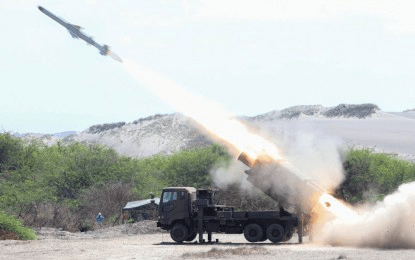
MANILA – The Japanese Type 88 surface-to-ship missile system, fired for the first time in a Balikatan exercise, sank the decommissioned patrol corvette, former BRP Quezon (PS-70), during the maritime strike (MARSTRIKE) drills conducted off Ilocos Norte Wednesday.
In an interview with reporters, Philippine Balikatan spokesperson Marine Col. Dennis Hernandez said the MARSTRIKE drills that took place off the Paoay Sand Dunes started around 10 a.m.
Initially, a U.S. “Guided Multiple Launch Rocket System,” which has a range of around 70 kilometers, was fired as a “probing” round and used to determine the location of the target ship around 10:15 a.m.
After this, Hernandez said a “constructive simulation” was conducted where the U.S. NMESIS anti-ship missile system and the Philippine Navy’s C-Star sea-skimming surface-to-surface anti-ship cruise missile was fired via computer.
After this, Japan’s Type 88 surface-to-ship missile system fired two rounds around 10:30 a.m. and hit the hull of the target squarely. The Japanese weapon has a range of 180 kilometers and a warhead weight of 225 kilograms.
Incidentally, this is Japan’s first time to participate in Balikatan live-fire drills.
“Eventually after around 17 minutes, lumubog na siya. So hindi na nakapag-fire yun mga eroplano natin, yun FA-50 at yung (A-29) ‘Super Tucano’ hindi na naka-drop ng kanilang munitions (it sank, our aircraft were unable to fire, our FA-50 and ‘Super Tucano’ were unable to drop their munitions),” Hernandez said.
He also added that the U.S.’s “High Mobility Artillery Rocket System” fired at the spot where the ship sank.
Hernandez said that another live-fire drill will be conducted Thursday to provide military aircraft and other participants an opportunity to fire their munitions at a stand-by target vessel. (PNA)