By Connie Calipay
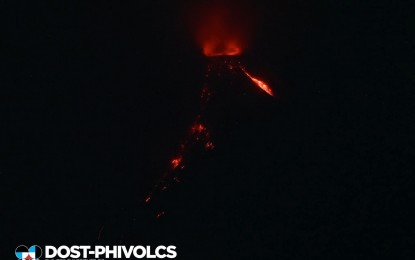
LEGAZPI CITY – The Philippine Institute of Volcanology and Seismology (Phivolcs) on Friday reported continued volcanic unrest at Mayon Volcano and warned the public to remain outside the permanent danger zones due to possible hazardous activity.
In its 24-hour monitoring bulletin issued Friday, Phivolcs recorded episodic minor strombolian activity and short-lived lava fountaining.
Lava effusion produced lava flows reaching 3.8 kilometers in Basud Gully, 3.2 kilometers in Bonga Gully and 1.6 kilometers in Mi-isi Gully.
Phivolcs logged a total of 71 volcanic earthquakes, including 39 volcanic tremors lasting two to 68 minutes, along with 421 rockfall events and six pyroclastic density current signals.
Sulfur dioxide flux averaged 889 tonnes per day on Thursday, while a 750-meter-high plume drifting west-southwest was observed.
Ground deformation data indicated short-term deflation of the edifice with short-term inflation on the northeastern flank.
Meanwhile, Bulusan Volcano in Sorsogon province remained under Alert Level 1. Phivolcs recorded nine volcanic earthquakes and sulfur dioxide emissions of 121 tonnes per day.
Bulusan also generated a 120-meter-high plume with moderate emission drifting south-southwest. Ground deformation monitoring showed short-term inflation of the volcanic edifice.
Phivolcs reiterated that entry into the permanent danger zone is prohibited due to the possibility of sudden steam-driven or phreatic eruptions. (With a report from Melrose Lagonoy, OJT/PNA)