By Nanette Guadalquiver
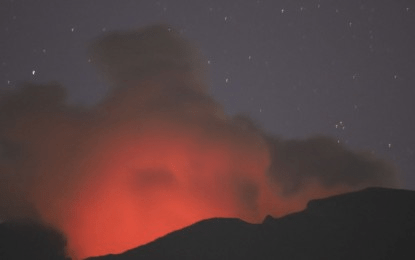
BACOLOD CITY – Kanlaon Volcano Observatory (KVO) resident volcanologist Mari-Andylene Quintia on Monday reiterated the warning against entering the volcano’s four-kilometer permanent danger zone (PDZ) after the sighting of the crater glow on Sunday evening.
“The crater glow seen Sunday might persist. If it is sustained or intensifies, that might be an indication of a magmatic eruption,” she said in an interview.
Quintia, who is based at the KVO in La Carlota City, Negros Occidental, said volcanic hazards can be generated once an eruption occurs.
“We warn the public not to enter the PDZ,” she added.
In an advisory issued Monday morning, the Philippine Institute of Volcanology and Seismology (Phivolcs) said around 7 p.m. on Sunday, the KVO “reported observing with the naked eye for the first time incandescence at the Kanlaon Volcano summit caused by superheated volcanic gas, followed by netizen reports of the same observations.”
“Such a phenomenon, when it becomes visible to the naked eye, is called crater glow or ‘banaag,’ a common precursor of magmatic eruption (similar to) Mayon Volcano,” it added.
Still with the new development, “monitoring parameters have persisted at approximately the same level after Kanlaon’s last moderately explosive eruption on March 15, 2026.”
In the advisory, Phivolcs reminded the public that “while Alert Level 2 prevails over Kanlaon, the alert status may step up to Alert Level 3 should magmatic eruption be forewarned by sustained and intensifying crater glow or ‘banaag’ at the summit crater.”
“Local government and disaster risk reduction partners must ready their response measures, paying special attention to the vulnerable members of the community, including the elderly, those with medical conditions, expecting mothers and infants,” Phivolcs said.
It also advised “increased vigilance against potential syn-eruption lahars and sediment-laden streamflow in channels draining should intense rains occur during eruptive unrest.” (PNA)